
 By clicking you show your interest in this initiative. This will enhance the chances of: 1) obtaining more information from those responsible for the initiative, in case it was shared by others or has limited information; 2) participating in an online discussion forum or assisting a webinar about this particular initiative, similar ones or related topics. Those responsible for the initiatives that raise the highest interest will be contacted to provide more information and/or take part in a discussion forum or webinar (example here full datasheet).

Add this initiative to my favorites
Remove this initiative to my favorites
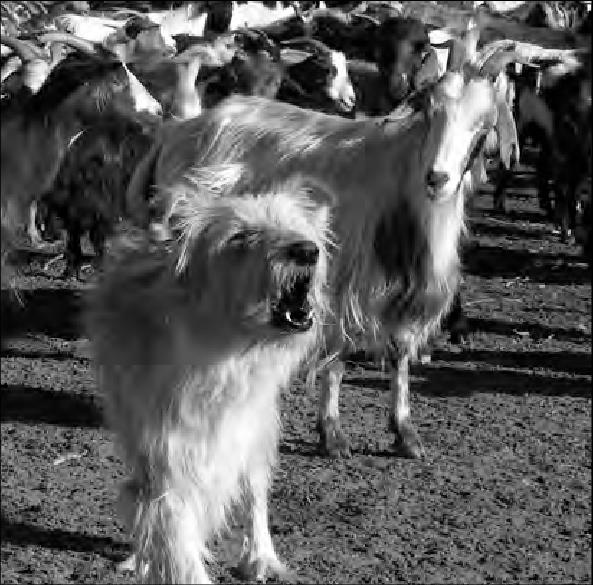
In this study, they "evaluated the use of local, medium-sized, mixed-breed guarding dogs to reduce predation and retaliatory killing of carnivores. They interviewed 64 herders, and delivered 37 puppies to 25 herders. Most economic loss was attributed to cougars (Puma concolor) and culpeos (Lycalopex culpaeus). All herders with dogs that reached the working stage reported reduced rates of predation, and 88% reported that they no longer kill carnivores. Among herders who were not using dogs, 89% of them reported increased predation, and 100% of them confirmed that they kill carnivores. Mixed-breed dogs can be effective in reducing both predation losses and retaliatory killing, but their success depends on the ability and willingness of herders to train and use them properly.
 |
| Livestock guarding dogs |
 |
| Puma |
 |
| Livestock |
 |
| Argentina |
 |
| https://www.researchgate.net/publication/235975924_Mixed-breed_guarding_dogs_reduce_conflict_between_goat_herders_and_native_carnivores_in_Patagonia |
 |
| - |
Addressing Human – Wildlife interaction issues often requires a combination of diverse initiatives. While many of these already exist, they are spread out across the globe in such a way that many remain unknown and not available to all.
The ENCOSH platform has been co-created by an international, interdisciplinary team to foster and help practitioners worldwide to share their knowledge and experiences
Please do not hesitate to contact us for further information and guidance or share any suggestions to make this new platform the most suitable to your needs and expectations: https://encosh.org/contact/
Please, take into account that is an automatic translation made by a computer; the translation may not be always very accurate. If this translation is not clear enough in your native language, please let us know here: https://encosh.org/en/contact/. Donations will help paying professional translators for including qualitative translations instead





Interesting initiative! Having to face a similar issue in French Guyana with jaguars and pumas predating over livestock, I would have some questions to set up efficiently protecting dogs within a livestock flock:
– How do you organize to protect your livestock when dogs are still puppies and then potential prey for large carnivores as pumas?
– How do you know when dogs are “ready” to effectively protect livestock? Do you need a test period to improve their protection before letting alone with the livestock?
– Are these mixed-dogs can be included within different type of livestock breed (goats, buffaloes, cows, zebus…)?
– How many dogs do you need depending on the size of the livestock?
Thanks for your feedback.
Hi Tommy, I was just passing through and thought I would respond seeing as no-one else has!
I train farmers to implement successful livestock guardian dog strategies in their operations to prevent predation and thus create a predator friendly environment.
To answer your questions –
– You are correct. Puppies are vulnerable and will become prey themselves. We advise that only mature LGDs should be left in pastures. Juvenile LGDs over the age of 12 mths can join the adult LGDs depending on the predator pressure. Adult LGDs can help train the juvenile LGDs “on the job.” However the shepherd still needs to develop a relationship with their dogs so handling and training should still also be carried out by the shepherd. Succession planning of LGDs is an absolute must to avoid losing protection of livestock.
– Most LGDs aren’t ready to be left alone with livestock until around 2yrs of age. There are some exceptions of course especially where there are older mature LGDs to assist and supervise the juveniles whilst they are “coming into their own” abilities. Juveniles tend to want to play with livestock and can injure or kill livestock accidentally.
– mixed breeding must only be between recognised LGDs. Non-LGDs do not have the instinct to protect livestock in the way that true LGDs do and can. The success of any LGD program will depend on the nature of the stock to be protected. For example, buffalo are very wary and will take longer to accept the presence of a dog. Donkeys don’t always get on with dogs. It is generally harder for an LGD to bond with chickens because they are noisy and flighty, but they can be very successful with any type of fowl.
– how many dogs you will need is dependant on many, many things. We always say that two dogs is the minimum to start with for any operation.
I hope this helps with your understanding of livestock guardian dogs.