
 By clicking you show your interest in this initiative. This will enhance the chances of: 1) obtaining more information from those responsible for the initiative, in case it was shared by others or has limited information; 2) participating in an online discussion forum or assisting a webinar about this particular initiative, similar ones or related topics. Those responsible for the initiatives that raise the highest interest will be contacted to provide more information and/or take part in a discussion forum or webinar (example here full datasheet).

Add this initiative to my favorites
Remove this initiative to my favorites
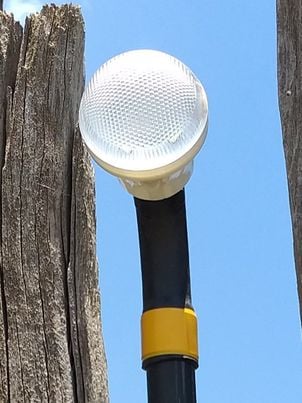
To discourage predator attacks at night, flashing predator deterrent light systems are mounted on livestock enclosures. This idea is intended to fool predators into thinking there is someone walking around with a torch during the night, and it is too dangerous to target livestock. It is said to be 99% successful, with only 1% of recorded cases of predators, especially lions, crossing the lights.
A livestock pen/enclosure is surrounded by flashing white light - LED bulbs. The number of bulbs used in an animal enclosure is determined by the size of the enclosure and usually ranges between 8 and 12 bulbs per livestock enclosure. Micro solar panels mounted just above each bulb or a central solar panel supply power to lights (Depending on the model of the light and supplier). The device includes a light sensor that switches on the flashing light bulbs automatically when it gets dark. the system is as simple as switching on and off on intervals a light torch as a warning that you are on the watch.
In Kenya, three organizations, Lights for Life, Coexist Tech, and The Wildlife Foundation, are using this system to reduce human-wildlife conflict in high-risk areas near wildlife protected areas. In terms of installation costs, one predator deterrent light bulb usually costs around $20, while a set of lights plus installation costs around $300.
The device is most efficient for carnivore deterrence at night and aids in the protection of enclosed livestock raids by carnivores at night and when it rains (which tend to occur often during the rains).
 |
| Visual deterrents and repellents |
 |
| Cheetah |
| Hyena |
| Leopard |
| Lion |
| Wild Dog |
 |
| Livestock |
 |
| Kenya |
| Narok and Kajiado Counties, Kenya |
 |
| https://www.facebook.com/Light-For-Life-117351708470628/photos/?ref=page_internal |
| http:// www.thewildlifefoundationkenya.org |
| https://www.linkedin.com/in/michael-mbithi-b5753447/?originalSubdomain=ke |
 |
| miliatukai@gmail.com |
Addressing Human – Wildlife interaction issues often requires a combination of diverse initiatives. While many of these already exist, they are spread out across the globe in such a way that many remain unknown and not available to all.
The ENCOSH platform has been co-created by an international, interdisciplinary team to foster and help practitioners worldwide to share their knowledge and experiences
Please do not hesitate to contact us for further information and guidance or share any suggestions to make this new platform the most suitable to your needs and expectations: https://encosh.org/contact/
Please, take into account that is an automatic translation made by a computer; the translation may not be always very accurate. If this translation is not clear enough in your native language, please let us know here: https://encosh.org/en/contact/. Donations will help paying professional translators for including qualitative translations instead





Very interesting initiative. When was it initiated?
Do you know the duration of the efficacy of such light system?
Do predators eventually get used to the lights and ignore them?
Thanks for any further information.
The idea has been around for a long time and was first implemented in Europe and North America, but it was pioneered in Kenya eight years ago. When the lights go out, you will need to replace the battery, but the supplier’s kit normally includes maintenance for a year (in the case of lights for life), so you can still call and they will come and do the maintenance. It is claimed that the lights are 99 percent effective, with only one case of a lion being confirmed to have crossed the lights since they were first installed in Kenya.
Dear Jacob,
Are there some scientific data available about its efficiency, from short to long term, and against various animal species?
Did you try to combine other deterrents with this one to increase the efficiency of livestock protection at night?
Dear Jacob – I’m interested to know what is the minimum lumen (brightness) needed for the lights, so that the predators are deterred. As we know, LED bulbs come in many different strengths.
how can I get the light