
 By clicking you show your interest in this initiative. This will enhance the chances of: 1) obtaining more information from those responsible for the initiative, in case it was shared by others or has limited information; 2) participating in an online discussion forum or assisting a webinar about this particular initiative, similar ones or related topics. Those responsible for the initiatives that raise the highest interest will be contacted to provide more information and/or take part in a discussion forum or webinar (example here full datasheet).

Add this initiative to my favorites
Remove this initiative to my favorites
Working as a shepherd in the Pyrenees is a challenge since bears are around. Yannick Lamazou produces cheese up in the mountains in the National Park and found a good way of promoting bears and sheep at the same time.
Yannick Lamazou is the son of a shepherd who has been working as a mountain shepherd in the National Park of the Pyrenees (Lapachouaou hut) for 12 years in the Pyrenees brown bear area. His 300 ewes herd has never been attacked. He faced problems with stray dogs which is a problem much more important than the bear or the wolf presence. There have always been bears here. Shepherds always had to live with them. Yannick is not afraid of being attacked: watching the herd is crucial. Every night Yannick parks his sheeps in an electrified enclosure with his guarding dog.
There are only two remaining male bears between the Aspe and Ossau Valleys. If the bear would disappear, his job and the mountain economy could disappear too. Thus he’s asking for a reinforcement of the bear population in this part of the Pyrenees.
Following the results of a marketing survey showing the interest of local cheese makers, the Fonds d'Intervention EcoPastoral (FIEP is a Pyrenees association) launched a programme to establish the brand “Pé Descaous” for cheese made out of sheep milk. "Pé Descaous" is a nickname of the bear in Basque and means barefoot "Le va-nu-pied".
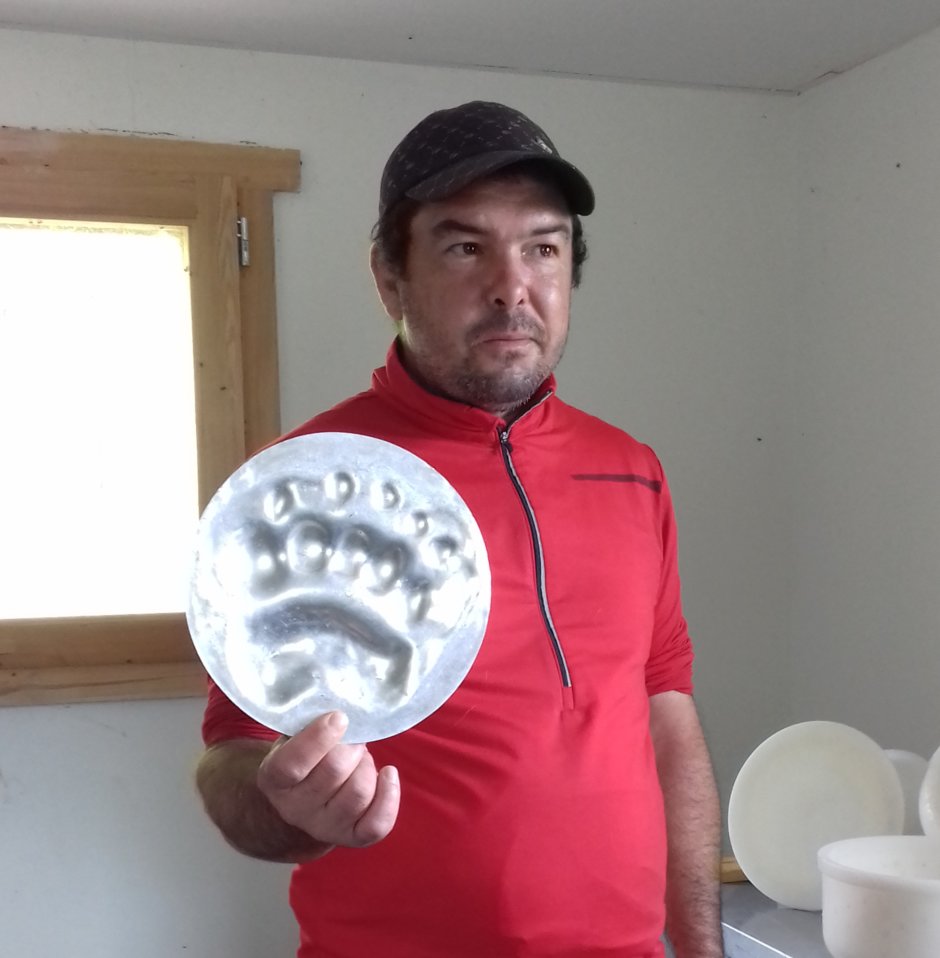
Yannick is one of the 14 "Pé Descaous" cheese producers who want to preserve their way of life and cultural cheese-making, and who are in favor of the conservation of bears. As a part of this programme he produces the Pé Descaous sheep cheese in his shepherd’s hut in the mountain pasture following strict specifications (sheep of local breeds, daily cheese making…). A plaster moulding of a bear paw is printed on the cheese so that the product supports the shepherds as well as the bears. The promotion of the cheese was also part of the LIFE Coex programme.
Large carnivores can have a negative influence on the economic situation of local citizens working in an area. On the other hand their presence can be a chance to create economic success. The branding of local products that are linked with large carnivores can help to raise awareness and interest for the conservation of wolf, bear or other carnivores. This can also be an opportunity for tourism. For example cheese made of milk from sheep or honey that are produced in a bear area can be branded with the names and/or symbolic elements of the protected species.
Yannick sells his cheese in plain in autumn using the symbol of bear. That brings added value to a product from the bear area and it brings him more money. His customers the creameries are happy to buy cheese with the bear footprint produced by shepherds who respect their environment. The presence of bears in the Pyrenees also allows shepherds to benefit from financial supports from the Government. These supports help them do their job better by financing a large part of helicopter and mule transportation as well as guarding dogs. Without these financial supports shepherds couldn’t afford these services.
 |
| Financial benefits |
 |
| Wolf |
 |
| Bees |
| Human well-being |
| Livestock |
 |
| France |
| Nouvelle-Aquitaine, Pyrénées |
 |
| https://www.eurolargecarnivores.eu/fr/feature/yannick-lamazou |
 |
| - |
Addressing Human – Wildlife interaction issues often requires a combination of diverse initiatives. While many of these already exist, they are spread out across the globe in such a way that many remain unknown and not available to all.
The ENCOSH platform has been co-created by an international, interdisciplinary team to foster and help practitioners worldwide to share their knowledge and experiences
Please do not hesitate to contact us for further information and guidance or share any suggestions to make this new platform the most suitable to your needs and expectations: https://encosh.org/contact/
Please, take into account that is an automatic translation made by a computer; the translation may not be always very accurate. If this translation is not clear enough in your native language, please let us know here: https://encosh.org/en/contact/. Donations will help paying professional translators for including qualitative translations instead





Bravo Yannick, et surtout très belle initiative. L’électricité de ta clôture électrique est solaire ou à partir d’un groupe électrogène? Je souhaite aussi savoir, comment tu nourris ton bétail dans les pâturages ou depuis l’enclos?
Je t’écris depuis le Gabon, car nous avons aussi des conflits avec les panthères.
Bonjour,
Je me permets de répondre sachant que j’ai posté cette initiative bien que je ne connaisse pas Yannick directement. AU sujet des clôtures électriques, il y a plusieurs fiches techniques disponibles sur la plate-forme, vous pouvez y accéder via les boites à outil et les filtres de recherche. Il semble que les clôtures doivent être spécifiques à l’espèce (nobre de fils, hauteur, voltage). Par exemple, pour les jaguars et les pumas, j’utilise des clôtures électrique solaire à 5 fils (20,40,60,80,130cm par rapport au sol) et minimum 5000V.