


Add this initiative to my favorites
Remove this initiative to my favorites

A properly constructed electric fence is safe for people and pets and has proven to be effective at deterring bears from apiaries (beehives), fruit trees, gardens, livestock pens, rabbit hutches, garbage containers, dog kennels, chicken coups, compost piles, storage sheds, along ...
Read
Add this initiative to my favorites
Remove this initiative to my favorites

Peppi and Marko Laine are sheep farmers from Salo, Finland. Over the past years the sightings of wolves has increased from only a few to almost a hundred. Last year two of their lambs were killed by wolves. Now they are testing if llamas would be suitable guardians for their shee...
Read
Add this initiative to my favorites
Remove this initiative to my favorites

Installation of a biological barrier (composed of urine and faeces from another pack of wolves than those identified on the territory) of 65 km on a territory where 3 packs of wolves live to protect a herd of 2,400 ewes impacted by predation, in Idaho in the United States.
...
Add this initiative to my favorites
Remove this initiative to my favorites

HWC toolkit was developed to help communities adjacent to protected area. The toolkit contained a combination of Torch, Horn, Fire cracker and Roman candle. The toolkit is used sequentially. More than 1200 individual were trained within Tarangire - manyara ecosystem and Kilimanja...
Read
Add this initiative to my favorites
Remove this initiative to my favorites

Honeyguide HEC Prevention Methodology
Working with community youth volunteers and wildlife scouts, Honeyguide developed a Human-Elephant Conflict (HEC) Toolkit that uses a sequential order of methods to prevent crop destruction. The objective of the HEC Toolkit is to...
Add this initiative to my favorites
Remove this initiative to my favorites

Solar-electric poliwire fencing is aimed at mitigating the impact of elephants on the livelihoods of subsistence farmers. It is a small, portable, farm-based initiative used during each cropping season to deter elephants from individual fields, while allowing them to continue to...
Read
Add this initiative to my favorites
Remove this initiative to my favorites

The design of the electric fence introduced here was tested by the NGO Panthera to prevent felines such as Jaguar and Puma from attacking livestock. The number of wires, their height and voltage are 3 parameters
essential to consider, such as:
- 5 wires at 20cm, 40c...
Add this initiative to my favorites
Remove this initiative to my favorites

We aim to test two new non-lethal methods to prevent sheep predation by wolves.
One method consists in a lightweight cover made of fabric stripes impregnated with a concentrated chili pepper extract and hanging around the sheep: a "defence harness". The harness should not ...
Add this initiative to my favorites
Remove this initiative to my favorites
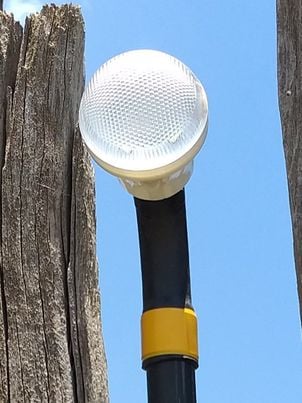
To discourage predator attacks at night, flashing predator deterrent light systems are mounted on livestock enclosures. This idea is intended to fool predators into thinking there is someone walking around with a torch during the night, and it is too dangerous to target livestock...
Read
Add this initiative to my favorites
Remove this initiative to my favorites

The first attractant of elephants to our fields is the different crops grown within, such as maize, sorghum, millet etc. Therefore, this trials hold a strong position that evaluating alternative cropping strategies can bring about a significant knowledge, understanding and more i...
ReadAddressing Human – Wildlife interaction issues often requires a combination of diverse initiatives. While many of these already exist, they are spread out across the globe in such a way that many remain unknown and not available to all.
The ENCOSH platform has been co-created by an international, interdisciplinary team to foster and help practitioners worldwide to share their knowledge and experiences
Please do not hesitate to contact us for further information and guidance or share any suggestions to make this new platform the most suitable to your needs and expectations: https://encosh.org/contact/
Please, take into account that is an automatic translation made by a computer; the translation may not be always very accurate. If this translation is not clear enough in your native language, please let us know here: https://encosh.org/en/contact/. Donations will help paying professional translators for including qualitative translations instead